Stelau courses / EPITA · EGE · ESG

  • AES
  • RSA
  • SHA
  • DH
  • PRNG

Cryptography
takes shape.

Algorithms are building blocks. Understanding how they fit together is the first step towards understanding a system’s security.

Over fifteen years of teaching, informed by Stelau’s work in the field.

01 / The common language

Five primitives.
A whole world of possibilities.

Symmetric and asymmetric cryptography, hashing, key agreement and randomness: watch data move, keys come into play and results appear.

The five primitives in action
Course animation · automatic playbackOpen this slide in the course ↗

Original GSAP course scenes. Values and parameters are simplified to explain the mechanisms; SHA-1 and small-number Diffie–Hellman examples are for teaching.

02 / The guiding idea

Security depends on
the assembly.

A certificate is a static file. An electronic passport combines protocols to authenticate a chip, establish a protected channel and control access to its data, including sensitive biometric fingerprints. The same questions connect them.

01Who holds which key?

02What is signed, encrypted or verified?

03What happens when a component is missing?

The course provides the foundations for reading these constructions and discussing their guarantees and limitations.

03 / Inside the course

The constructions
take shape in front of you.

01 / X.509

A certificate is already an assembly.

An identity, a public key and an authority’s signature. Watch the file take shape, from the digest to verification.

Assembling a certificate
Course animation · automatic playbackOpen this slide in the course ↗

Teaching model: the signature covers the displayed data. A real X.509 certificate uses an ASN.1 structure and requires additional validation rules.

02 / TLS

A secure connection has an architecture.

Key agreement, authentication, encryption and derivation: identify what each component contributes to TLS.

Reading a TLS assembly
Course animation · automatic playbackOpen this slide in the course ↗

Cipher-suite names include TLS 1.2 examples. TLS 1.3 negotiates key exchange and authentication separately. The diagram simplifies the exchanges.

03 / AES-128

One bit changes. The effect spreads.

Substitution, row shifting, column mixing and round keys: watch AES bytes actually change.

Watching an AES round
Course animation · automatic playbackOpen this slide in the course ↗

04 / RFC 6238

Time becomes part of the calculation.

A shared secret, a time counter and an HMAC: follow a TOTP code calculation and its renewal window.

From a secret to a TOTP code
Course animation · automatic playbackOpen this slide in the course ↗

The first two rows illustrate simplified hashes. The lower calculation follows RFC 6238: HMAC, a 30-second counter and dynamic truncation. A TOTP code is computed locally; it is not an SMS.

04 / Learning by doing

Your turn
to assemble.

The EGE syllabus combines illustrated teaching with team workshops. No prior theoretical knowledge of cryptography is required: the course progresses from the five building blocks to systems that combine them.

Workshop / Interception

“Attack me if you can!”

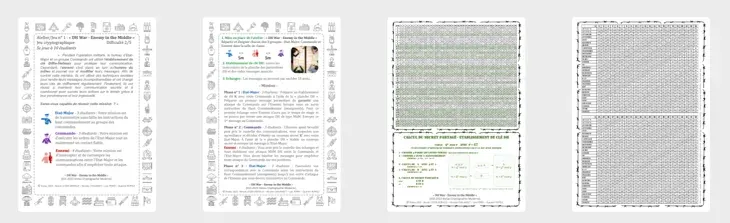
The four DH War game sheets: instructions, roles and tables used in the interception workshop.

Ten players. Three roles. Who controls the message?

Three at headquarters issue orders, three commandos must carry them out, and four enemies intercept and tamper with messages. Agree on a secret using Diffie–Hellman, then keep communicating when the enemy takes over the channel. Can you get the genuine attack order through?

Game rules · PDF in French

Workshop / Cryptographic puzzle

WannaCry nightmare

WannaCry Nightmare puzzle sheets laid out on a table with a candle and a coffee.

Strong encryption. An unexpected way out.

2017: leaked NSA tools, a global attack, files held hostage… then traces of private keys found in memory on some Windows systems. In a team of five, reconstruct WannaCry’s cryptographic design and follow the trail. How could formidable encryption still leave a chance to recover the files?

Story and resources · in French

The building blocks meet real life.

Identity documents, Bitcoin, TLS, VPNs, messaging, visible digital seals and electronic signatures: practical cases to learn how to explain a mechanism, beyond naming it.

Keep experimenting

Understanding the primitives.
Exploring the protocols.

Continue with OIDApp and its CryptoLab: sign, tamper, verify and learn how OpenID protections work through hands-on experiments.

Explore OpenID / CryptoLab

Bring this course to your school?

At EPITA, EGE and ESG, the content adapts to the audience and available time. Let’s discuss your programme.

Contact Stelau

Find what interests you.

Expertise, projects and articles. Escape to close.